Bilingual answering service
A bilingual answering service for Spanish and English callers
Evoriqa is a bilingual answering service built on one rule you should know first. Each phone line answers in the single language you set for it, so a Spanish line and an English line cover both, while chat, WhatsApp and SMS reply in whatever language the customer writes in, across 32 languages. Here is how that works in practice.
Free plan, no credit card. Call your own line before you commit.
What a bilingual answering service does
It takes the call in the caller's language, so nobody has to ask for a Spanish speaker.
- Answers in the language you chose
- Each phone line is set to a language, and the agent listens and answers in it for the whole call. You write that line's greeting in the same language.
- Uses one set of content
- The agent draws on the same website pages, documents and FAQs whichever language the question arrives in, so there is nothing to keep in two places.
- Books, captures and hands over
- It offers free slots on your connected Cal.com or Calendly calendar, takes the caller's details, and transfers to your team when your rule says to.
- Leaves a transcript in the language it happened in
- Whoever picks the conversation up reads what was actually said, not a summary flattened into English.
Underneath it is the AI answering service described elsewhere on this site, with the phone language chosen per voice channel.
When a human bilingual service is the better fit
If your callers move between English and Spanish within a single call, a person is the better answer: a trained bilingual operator can follow that, and our phone line cannot. The same goes for businesses that want a human on every call. We would rather you know that before you connect anything. A human service on the phone with an agent on the typed channels is a perfectly good split.
Spanish and English on the phone
A phone line has one language. A bilingual business connects a line for each.
The phone side is one language per line: the language you set for that line. Spanish is one of the phone languages, and so is English. The agent does not detect which language a caller is speaking, and it does not switch partway through a call.
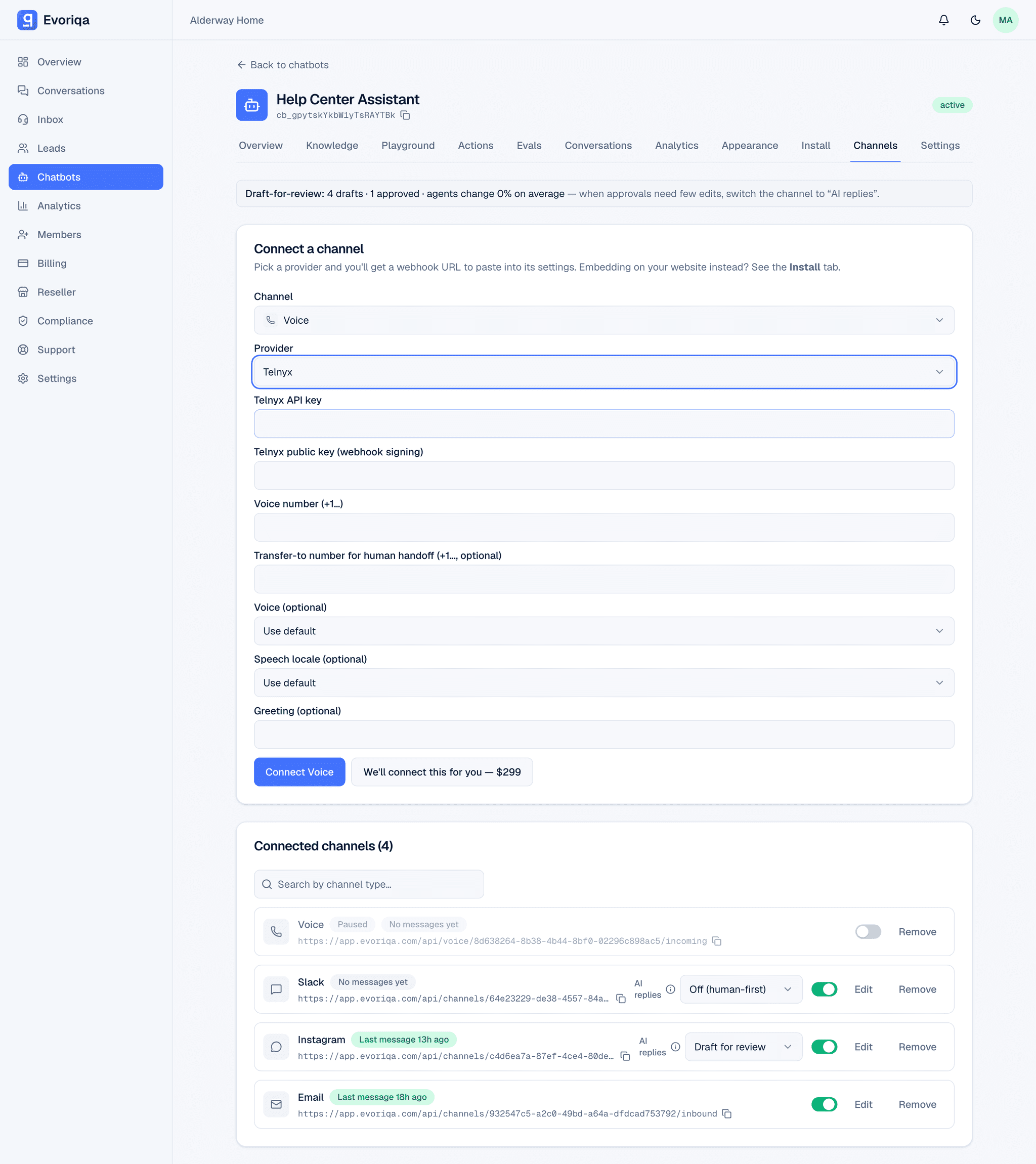
The setup that keeps everything else multilingual: leave one chatbot on its default language, so chat, WhatsApp and SMS keep replying in the customer’s own, and connect two voice channels to it, a Spanish line and an English line. In each voice channel’s settings you give that line its language. Both lines share the chatbot’s knowledge, so there is one set of content to keep up. It works on the Free plan, within its voice minutes and the two provider numbers you supply. Pinning the chatbot itself to Spanish would make chat single-language too, which is rarely what a bilingual business wants.
Write the Spanish line’s greeting in Spanish in that channel’s settings. The spoken greeting is served exactly as you configure it, English by default. The AI-disclosure line callers hear first is set on the chatbot, not per channel, so both lines speak the same single text, served as configured. Write it to work for callers on both lines, then call each line and listen to it.
So the work is getting each caller to the right line. Three ways to do that:
- Two numbers, published side by side
- List an English number and a Spanish number on your site and cards. Each number is forwarded to its own line in Evoriqa.
- A phone menu at your carrier
- Some phone providers offer a menu that sends a caller to one number or another (the familiar “para español, oprima dos”). Whether yours does is up to them, so ask before you plan around it.
- Spanish only, or English only
- If nearly every caller prefers one language, a single line in that language is the simplest setup, with chat covering the rest.
Connecting a line takes a Telnyx or Infobip number and, if you want callers to keep the number they know, a forward from your existing line. The voice channel page covers the setup.
Every language on chat, WhatsApp and SMS
Here the customer never has to choose, and nobody has to route them.
Typed channels behave differently from the phone. On WhatsApp, SMS and your website chat, the agent reads the language a message arrives in and replies in it, across 32 languages. A customer who writes in Spanish gets Spanish and the next one who writes in English gets English, from the same agent and the same knowledge base. The multilingual chatbot page goes further into how that works.
For a bilingual business that is often the easier half to get right. Put a text number or chat widget on the Spanish materials you already hand out, and nobody needs a second number to dial. A text number is still a number from your provider that you supply. What stays in English are the dashboard, email notifications, the default texts on messaging channels, and the voice greeting and spoken disclosure defaults, so write your own wording where it matters.
What it costs
Language does not change the price of a minute.
A Spanish line and an English line draw on the same monthly voice allowance, at about 2,500 credits a minute whichever language it is spoken in. Chat draws on that pool too, so the table shows each plan’s ceiling for voice alone. Every line you forward to is a Telnyx or Infobip number billed by that provider, on top, so a second language means a second of those.
- Free free
- 10 voice minutes / month
- Starter $29/mo
- 120 voice minutes / month
- Pro $99/mo
- ~520 voice minutes / month
- Business $399/mo
- ~2,100 voice minutes / month
Run out and nothing breaks: conversations are still captured for your team, and a one-time top-up pack is priced at the same per-credit rate as the plan of the same size. The pricing page has the full credit table.
Frequently asked questions
What is a bilingual answering service?
It is a service that picks up your business calls for you in two languages, most often Spanish and English in the US. A human service staffs bilingual agents; Evoriqa is an AI agent that answers each phone line in the language you set for it and, on chat, WhatsApp and SMS, in the language the customer writes in.
Can the AI answer in Spanish and English on the same phone number?
Not on one line. A phone line answers in the one language you configure for it, and Evoriqa does not detect the caller's language or switch partway through a call. To cover both, connect a line for each language and let callers reach the right one: two published numbers, or a phone menu if your carrier offers one.
What happens if a Spanish speaker reaches the English line?
The line stays in its configured language. The agent does not notice the caller is speaking another one and move across, so that caller may not be understood or well served. That is why the route to the right line matters: publish both numbers clearly and, if your carrier supports a language menu, put it in front. If a person needs to take over, the call can be transferred to the number you set.
Does Evoriqa support Spanish on the phone?
Yes. Spanish is one of the languages a phone line can be set to, alongside English, French, German, Portuguese, Italian and Dutch. We publish no accuracy or voice-quality figures, so the sensible test is to connect a line, set it to Spanish and call it yourself with the questions your customers ask.
Which languages work on chat, WhatsApp and SMS?
Thirty-two, and the customer does not choose. Leave the chatbot on its default setting and it replies in whatever language the person wrote in. You can also pin a chatbot to one language if your brand must always answer in it. The languages guide in the docs lists all 32.
When is a human bilingual answering service the better fit?
When callers switch language mid-sentence, when you need a person on every call, or when the calls are delicate enough that someone should hear the tone. A trained bilingual agent can follow a caller from English into Spanish and back; our phone line cannot. Plenty of businesses are better served by a human service for the phone and an AI agent for the rest.
What does it cost to run two phone lines?
Voice minutes come from one monthly pool and are billed the same way whichever language the line speaks, at about 2,500 credits a minute. The Free plan includes 10 voice minutes and Starter ($29/mo) includes 120. Each line you forward to is a Telnyx or Infobip number billed by that provider, separately from Evoriqa, so two lines mean two of those.
Put your support on autopilot today
Point Evoriqa at your website and help docs, and your agent starts answering questions, capturing leads and booking appointments across every channel. Free to start, no credit card.